
How can higher education institutions become more gender equal and inclusive? This question was at the heart of the online international workshop “How Can Higher Education Become More Gender Equal?”, organised by KMOP Education & Innovation Hub in cooperation with the University of Macerata, Italy, as part of the PRO-GENDERING project.
Held on 5 November, the workshop brought together participants from across Europe to discuss challenges and approaches to advancing gender equality in academia, while presenting key resources developed through the project.
The event opened with a presentation of PRO-GENDERING by Chryssa Sotiriou, Project Manager at KMOP Education & Innovation Hub, followed by a discussion led by Dr Antonis Klapsis, Vice President of KMOP and Associate Professor at the University of the Peloponnese, on the question “Is Academia gender-blind?” The discussion explored how assumptions of gender neutrality can overlook inequalities in higher education.
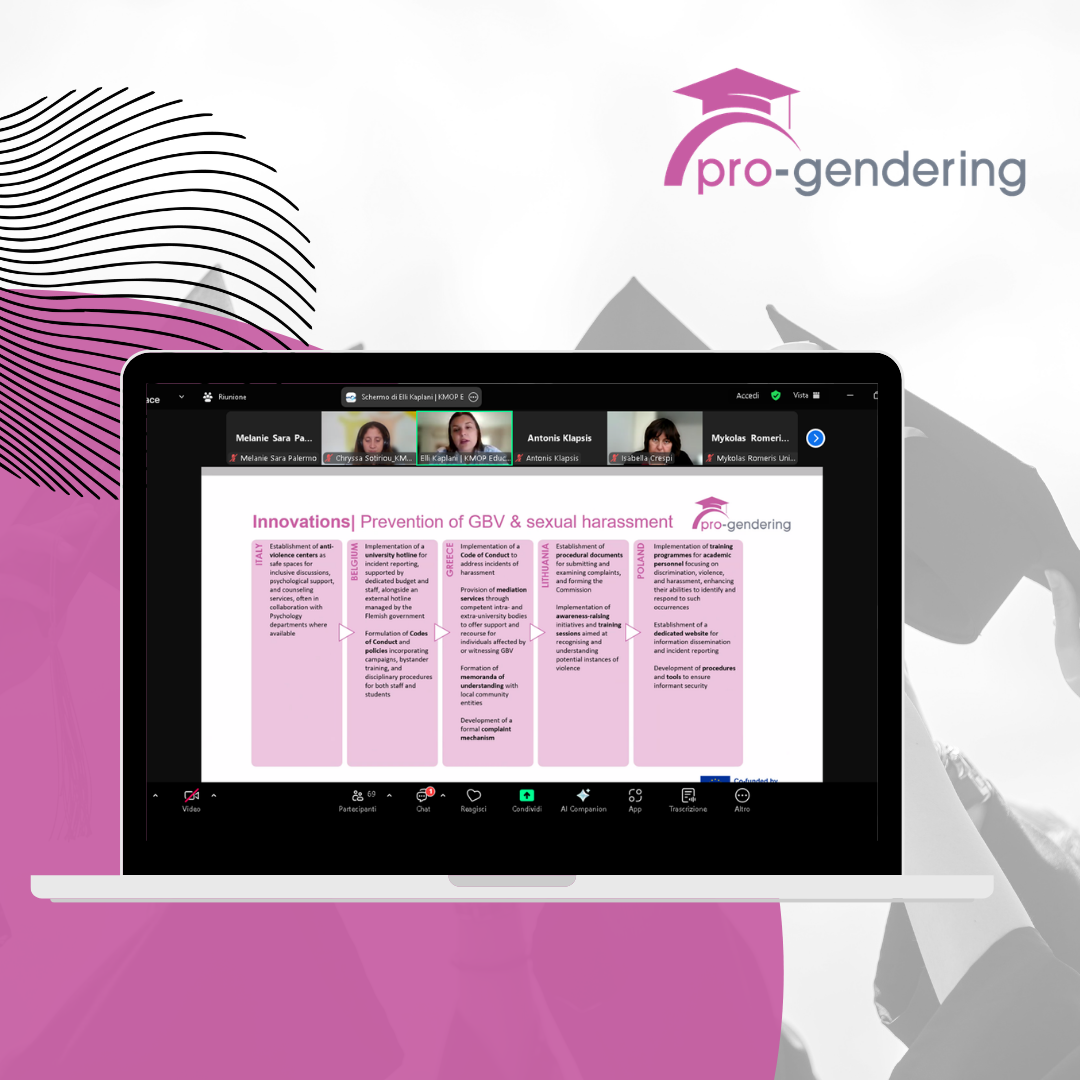
Elli Kaplani, Senior Researcher at KMOP Education & Innovation Hub, presented the project’s Comparative E-book of Country Reports, highlighting findings and experiences from the participating countries. Isabella Crespi, Coordinator of PRO-GENDERING at the University of Macerata, presented the Handbook on Implementing Gender Equality Plans in Higher Education Institutions, focusing on its practical value for universities working to strengthen gender equality.
Participants also discussed key issues including gender blindness in policymaking and evaluation, gender-based violence, community-building initiatives and good practices from partner and associated universities. The Q&A sessions provided space to exchange experiences and reflect on how gender equality can be better integrated into institutional policies and practices.
The workshop contributed to PRO-GENDERING’s wider efforts to support higher education institutions in promoting gender mainstreaming, equality and inclusion, while making the project’s resources more accessible to academics and other stakeholders across Europe.
The Handbook on Implementing Gender Equality Plans in Higher Education Institutions and the Comparative E-book of Country Reports are among the key resources developed through the project and can support universities in strengthening their gender equality approaches.